Scotland Yard
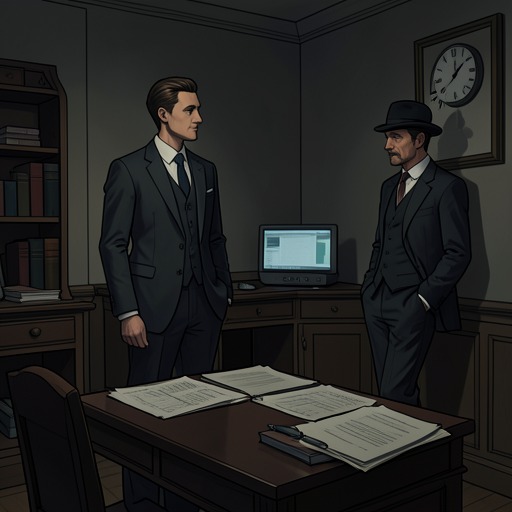
Partners in CrimeScotland Yard is the institutional counterpart to the Beresfords’ privately run detective work: it provides official authority, forensic expertise, intelligence, and armed support, while relying on Tommy and Tuppence to enter situations its officers cannot readily penetrate. Across their cases, the Yard appears not as a distant source of law but as a working partner—sometimes directing an operation, sometimes arriving at the decisive moment, and sometimes forced to acknowledge that the amateurs have seen what it missed.
Official authority and covert work
The Yard’s connection to the Beresfords begins with an assignment from their superior, Mr. Carter. He explains that the former proprietor of the detective agency, Theodore Blunt, is being detained at public expense after Scotland Yard intervened in his affairs. Tommy is offered six months’ leave on the stated ground of ill health and permission to operate the agency under Blunt’s name. The arrangement turns a private detective office into a useful cover for work connected to the Yard, while preserving a distinction between Tommy’s public role and the official service directing him.
Carter gives Tommy a concrete intelligence procedure. He is to watch for blue letters bearing Russian stamps, including messages associated with a ham merchant seeking his wife, who had come to the country as a refugee. Once the stamp is moistened, the number 16 can be seen beneath it. Tommy must copy the letters, forward the originals to Carter, and notify him immediately if anyone at the office refers to that number. The instructions make the Yard’s involvement operational and specific: a concealed number, a pattern of correspondence, and a reporting chain link the agency’s routine business to a wider investigation.
The Yard’s authority also underwrites Tommy’s investigations in less covert circumstances. When Tommy identifies Elise as a professional thief, he arranges for her to handle a glass slide, photographs her and the room, and takes the resulting material to Scotland Yard. The fingerprints are developed and identified there, turning a deduction about Elise’s access and the soap on her hands into evidence the police can act on. The Yard contributes the technical confirmation that the private investigator cannot establish by reasoning alone.
Evidence, expertise, and the limits of certainty
Scotland Yard’s work in the Merivale case illustrates both the strength and the fallibility of official interpretation. Inspector Marriot reports that the unidentified woman has been identified as Lady Merivale and that Sir Arthur has recognized her body. Sir Arthur identifies Captain Hale, known to his friends as Bingo, as a close friend who had been staying at his house when the arrest took place. Tuppence insists that Lady Merivale’s final words named Bingo. The Yard’s inquiry thus brings together identification, testimony, and a suspect whose relationship to the household complicates the case.
Marriot later presents what he calls a clear chain of evidence: letters indicate that Captain Hale and Lady Merivale had been involved for some time; the dagger was Lady Merivale’s; and a fragment of the Daily Leader found in the investigation matches the paper torn from the dress Hale wore. He considers the physical match the final link. Tuppence notices, however, that Marriot repeatedly emphasizes how clear the case is. The exchange leaves a small but telling tension between the confidence of a police conclusion and the Beresfords’ habit of scrutinizing how that conclusion has been reached. The Yard supplies evidence and a formal case theory; the detectives remain alert to the possibility that apparent completeness itself deserves examination.
The Yard also recruits the Beresfords’ powers of observation directly in the counterfeit-note investigation. Marriot shows them genuine notes and explains how to distinguish them from the fakes with a magnifying glass. He tells them that the notes are being circulated from the West End, that someone high in the social scale is distributing them, and that they are also passing across the Channel. He particularly wants information about Major Laidlaw. This is not merely a request to keep watch: Marriot explicitly entrusts the Beresfords with getting to the bottom of the matter, combining police knowledge of the circulation pattern with their independent access to people and places.
Arrests and coordinated operations
When the Russian-stamp investigation reaches its climax, Scotland Yard’s intervention depends on timing. A conspirator has found a blue envelope bearing a Russian stamp and is celebrating the discovery when Inspector Marriot and two armed men enter through the door from Tuppence’s office and order the group to raise their hands. The suspects are caught at a disadvantage: an automatic lies on the table, and the other two are unarmed. Marriot handcuffs them and calls the arrest a promising haul, expecting further results. The arrival converts an apparent victory for the conspirators into an immediate police capture, vindicating the intelligence protocol Carter had given Tommy.
The Yard’s intervention in the affair involving Beatrice Kingston Bruce is similarly visible and disruptive. Inspector Marriot identifies himself at the Beresfords’ office just as Beatrice breaks away from Tuppence and runs downstairs. Mr. Rennie is entering at the same moment, and Tuppence bitterly remarks that the timing has spoiled matters. The scene shows that official presence can secure a case while also upsetting a carefully managed encounter: police authority changes the movement of people in the room before the Beresfords have finished their own exchange.
At another point, the Yard’s power is present even when an officer remains outside the immediate scene. A man holding Tommy at gunpoint allows him to light a cigarette but warns him against tricks, insisting that the pistol is ready. The threat makes the imbalance explicit: Tommy is unarmed and being watched. In the surrounding exchange, he calmly maintains that his opponent has forgotten something, relying on a plan and on assistance beyond the captor’s immediate control. Across such encounters, the Yard’s role is not only to make arrests after a deduction; its resources and coordination help turn a vulnerable private investigation into an operation capable of confronting armed opposition.
A reciprocal partnership
Marriot’s relationship with the Beresfords is marked by professional respect rather than simple command. At lunch, he tells Tommy that Scotland Yard had long been dissatisfied with figures connected to the Porcupine Assurance case and had suspected the Hollabys, but had lacked grounds to act. The murder had disrupted the police’s assumptions. Tommy and Tuppence’s idea concerning a blue coat gives Marriot a way to confront young Hollaby and Doris Evans and test whether she recognizes him. He promises that Blunt’s Brilliant Detectives will receive credit for the idea, and Tuppence responds warmly. Marriot, in turn, says the Yard thinks highly of the pair.
That exchange explains the working arrangement more fully than a simple division between official police and independent sleuths. The Yard has accumulated suspicion but cannot yet convert it into action; the Beresfords contribute an inventive inference that makes a confrontation possible. Conversely, the Beresfords can gather clues and interpret behavior, but the Yard can provide identification, surveillance, armed officers, handcuffs, and the institutional means to bring suspects into custody. Credit is shared, even if the police retain the authority to make the arrest.
The Yard as a measure of the detectives’ methods
The Beresfords’ work repeatedly takes its shape from detective fiction, and Scotland Yard provides a practical counterweight to their play with fictional conventions. Tommy studies celebrated detective stories and proposes testing different styles, while Tuppence points out that he lacks the specialist medical, legal, and scientific knowledge associated with some fictional investigators. His answer is to buy a camera and photograph footprints for enlarged examination. The contrast anticipates the actual division of labor in their cases: amateur observation may generate a lead, but police technical practice can authenticate it.
The couple also assign themselves fictional roles when they suspect that an adversary has discovered Tommy is not the real Mr. Blunt. Tommy chooses to be Desmond Okewood, while Tuppence prefers Francis, the more capable brother who arrives in time to rescue the situation. Their mock assignments turn danger into a story they can manage together, but the actual solution depends on something beyond role-playing: access to Scotland Yard and cooperation with its officers. Later, Tuppence invokes the “little grey cells” while discussing a disguise involving a fireman’s kit, and Tommy answers in the manner of Hercule Poirot during a case involving No. 16. These performances make the detectives’ self-conscious imitation visible, while the Yard’s practical procedures keep the investigation grounded in evidence and action.
Across the book, Scotland Yard is therefore both a source of pressure and a partner in inquiry. Its arrival can interrupt a private plan; its confidence can invite scrutiny; and its investigations can stall for want of a usable link. Yet the Russian stamp, the fingerprint identification, the matched newspaper fragment, the magnifying glass, and the blue-coat deduction all show how the Yard turns clues into official knowledge and consequences. The Beresfords’ independence does not place them outside the police system: their most effective work repeatedly meets it at the point where suspicion becomes evidence and evidence becomes arrest.